
MegaVision is a pioneer in medium format digital cameras.
 |
MegaVision has a reputation for excellent service. Indeed when we encountered a glitch in the MegaVision back on a Hasselblad camera we were testing at the University of Malta in Europe, their tech support diagnosed the problem immediately as a potentially incompatible driver. They kindly sent a replacement computer card to resolve the situation.
We have noticed that MegaVision has three distinct assets:
-
They have been doing medium format digital photography longer than most competitors.
-
MegaVision still has its original digital visionary, Ken Boydston
-
Megavision has a long-time sales and marketing manager, Richard Chang, who also knows the technical aspects inside out.
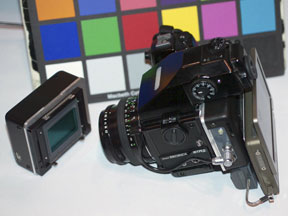
For several years MegaVision was going the OEM route, for aerial, medical, and industrial applications. At trade shows in those years they exhibited primarily together with other companies. But at PMA 2005 MegaVision had their own booth and showed their impressive 22-megapixel E-Series portable camera with an OQO computer. This provides both computing power, a good-sized monitor, and a 20 GB hard drive. MegaVision was back at PMA 2006 with their own booth as well. And I have seen MegaVision recently at Photokina 2008 in Cologne and PhotoPlus 2008 in New York.
Portability with the MegaVision E-Series medium format backs
I discuss the original MegaVision BatPac in the FLAAR course on digital photography. Today in 2009 of course everything has to be untethered. We specialize in shooting in remote locations so we can judge whether a camera system is truly portable, or not. The new MegaVision E-Series is a major advance in portability (we tried it out in mid-August and then again later in 2006). It was just as portable as the Imacon-Hasselblad, Leaf Valeo, or Kodak or Phase One medium format backs that I have tried earlier and since then).
MegaVision digital backs from past years include the
- E3 Series, 6-megapixel E3, 11-megapixel E 427; available in color or dedicated black-and-white.
- E4 Series, 16-megapixels, either color or dedicated black-and-white.
- E5 Series, E5, 22-megapixels, color only.
I saw no “News” when I checked in February 2009 (the page was down). And I see no new color digital backs listed since the 22-megapixel E5; the 39 megapixel back is B&W at present.
If you wish to see which portability solutions pass our strict requirements, you can sign up for learning about digital photography directly from Nicholas Hellmuth. He has spent most of his life in foreign countries photographing on location.
We have now tested the MegaVision black-and-white system twice during 2006. Our several reports on the MegaVision B&W are now available (by clicking on the title pages at the bottom of this and other pages).
Continue on our FLAAR digital-photography.org website for comparative comments on all the other medium format digital backs: Imacon-Hasselblad, Kodak, Jenoptik + Sinar, Leaf, and PhaseOne.
For conclusions, summary, and practical tips on which medium format would be recommended, again, this is what is covered in the reports by Nicholas Hellmuth which serve as the textbook for the course on digital photography.
Medium format digital photography in 2009
For the last year the medium format digital back that FLAAR has been using each month is a Phase One P25+. Part of the reason is the CaptureOne software from Phase One. The three photographers on the permanent staff of FLAAR prefer this CaptureOne software to use on the RAW images before putting the files into Adobe Photoshop CS4.
Another reason I have switched to Phase One is because these cameras are readily available at camera stores. The place we feature is Capture Integration because they also handle Cambo architectural cameras and because Capture Integration offers a unique infrared digital camera.
 |
 |
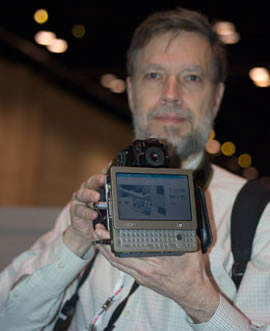
| Dr Nicholas Hellmuth finds this the absolutely ideal monitor for
photographing. He says: I prefer a large monitor so I can compose the
scene. Both for architectural photography, nature photography, or fine art
photography, a large monitor is an asset. This is the largest monitor of
any 22-megapixel medium format digital camera back in the world. We have experience with the Leaf Valeo and with the Hasselblad Imacon Ixpress, so when we try out the MegaVision e-series in the future, we will be able to tell how it compares with these two leading international brands of professional digital camera backs. |
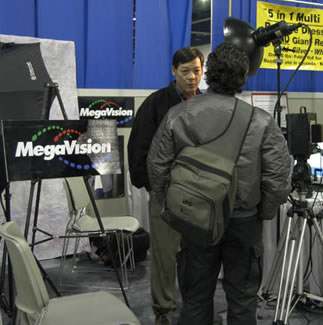
Here is Richard Chang, who helped us with tech support from California while we were training the Malta Centre for Restoration staff at the University of Malta, north of Tunisia. This is Richard at a PMA trade show a few years ago. |
Most recently updated Feb. 13, 2009.
Previously updated March 2003, during and after PMA photography trade show. Updated November 15, 2004, after Photokina and PhotoPlus 2004 trade shows, August 1, 2005.
|
Nicholas Hellmuth’s Medium Format Digital Camera InitiativeFor over 40 years Nicholas Hellmuth has used Rolleiflex and Hasselblad cameras to record the flora, fauna, and archaeology of Belize, Guatemala, Honduras, and Mexico. Now for several years he is extending his medium format experience to digital photography. Since FLAAR works both in a studio as well as out on location, we are an ideal focus for judging portability. We have experience with large format digital scan backs (the excellent BetterLight) and we also use Nikon and Canon digital cameras. A full-service digital pro should have at least one medium format digital system and should consider large format digital options as well. Although we started with a Leaf Valeo 22 coupled with a Mamiya 645 AFD body and lenses, we are open to showcasing all bodies as well as other digital backs. Indeed we have tested an Imacon 4-shot back on a Hasselblad H1 body. Then (February 2006 onwards) we are evaluated a MegaVision black-and-white dedicated back for fine art photography. Next we are testing a 33-megapixel Phase One P 30. Since 2008 FLAAR has used a Phase One P25+ (a great way to update an aging Hasselblad ELX body with its excellent Zeiss lenses). Camera resellers or manufacturers who wish to have their cameras, lenses, and backs included in this initiative are welcome to send their equipment for evaluation. FLAAR is the de facto source of information because we have been university based, independent, blunt, and we are one of the few review sources that dares to review advertising specs, advertising claims, and advertising hype. We can afford to reveal all the pros and cons because FLAAR is a research institute. Photographers feel they can trust a university research professor who has devoted years to understanding the pros and cons of each aspect of a digital camera system and workflow. Notice you are not blinded by blinking, flashing, or pesty ads for low-bid camera stores on a FLAAR photography review. I am always amused by a pseudo-review that obviously is simply paid to send you to a camera store. You can download our colorful FLAAR Reports on our medium format digital camera initiative. |
|||||||||||



Free Reports (Inquiry Form)







Additional links of our FLAAR sites |
| Rigid Printable Materials |
| Printing on Glass |
| Sandwich board for recyclable furniture! |
| Metallic Effects |
Free Download Reports
































| Home | About Us | Consulting | About FLAAR Reports | Site Map | Privacy Statement | back to top | ||||||||||||
|
||||||||||||||||||
www.digital-photography.org is part of the FLAAR network © 2001-2021. If you notice a bad link, missing photos, misspellings, please report to the webmaster:  Updates on wide format printers from 2007 onward are contained in the FLAAR Report. We update these reports constantly, so check out the over 187 titles which are now available. Updates on wide format printers from 2007 onward are contained in the FLAAR Report. We update these reports constantly, so check out the over 187 titles which are now available.
|
||||||||||||||||||
 |
||||||||||||||||||


